

There was a time in my life when, after closing down the company I owned, I was working all sorts of part-time jobs just to make ends meet. I affectionately refer to this period as my “rough-and-tumble years.” Looking back on it now, though, I’ve come to realize that those times were actually quite fun—mostly because I realized I had previously only known the tiny, insulated world of the publishing industry. The real-world wisdom I picked up back then seems to have done wonders for my perspective on life ever since.
When I ask myself what the most enjoyable part of those rough days was, the answer is hands down: having early-morning drinks and breakfast at the Tsukiji Fish Market. To make a decent wage doing part-time work, you naturally have to trade the healthy daytime hours for late-night shifts when everyone else is fast asleep. I found myself shifting to late nights more and more. I tried my hand at all kinds of overnight jobs—sorting air cargo at the airport, handling coastal logistics and delivery, cleaning hotels, and managing building security. But the best part of working through the night was that Tsukiji was a place where you could grab a drink at the crack of dawn without feeling a shred of guilt. Back then, the inner market (jonai) was still running, though rumors of its relocation were slowly starting to reach outsiders like us. I used to go there two or three times a week, which turned me into quite a Tsukiji expert.
I frequented all kinds of spots, both in the inner (jonai) and outer (jogai) markets. Inside, there was the Chinese restaurant Yajima, the Indian curry shop Nakaei, the traditional Japanese eatery Nakaya, and Toritoh with its famous oyakodon (chicken and egg over rice). Outside, I loved Inoue for ramen (sadly closed after a fire), Saukouken for Chinese, Choseian for soba, and Toto Grill for classic Western-style dining.
And that brings me to the place I want to introduce today: Kitsuneya, famous for its gyudon (beef bowl) and horumon-don (horumon bowl: simmered offal bowl). To be honest, calling it the most famous spot in the Tsukiji Outer Market wouldn’t be an exaggeration, and it’s so beloved that it’s practically Tsukiji’s ultimate soul food. It hardly needs an introduction, but as a self-proclaimed “Old-Timer Soul Food Researcher,” I felt I couldn’t skip it. So, for the first time in years, I headed back to the Tsukiji Outer Market.
However, since standard food reviews of this place have been done to death, I decided to take a different angle. Instead of a review, I embarked on a personal mission to investigate a question that has bothered me for a long time: Which actually sells more—the beef bowl or the horumon bowl? (Though, to be fair, asking the staff directly probably would have been the easiest way to find out…)

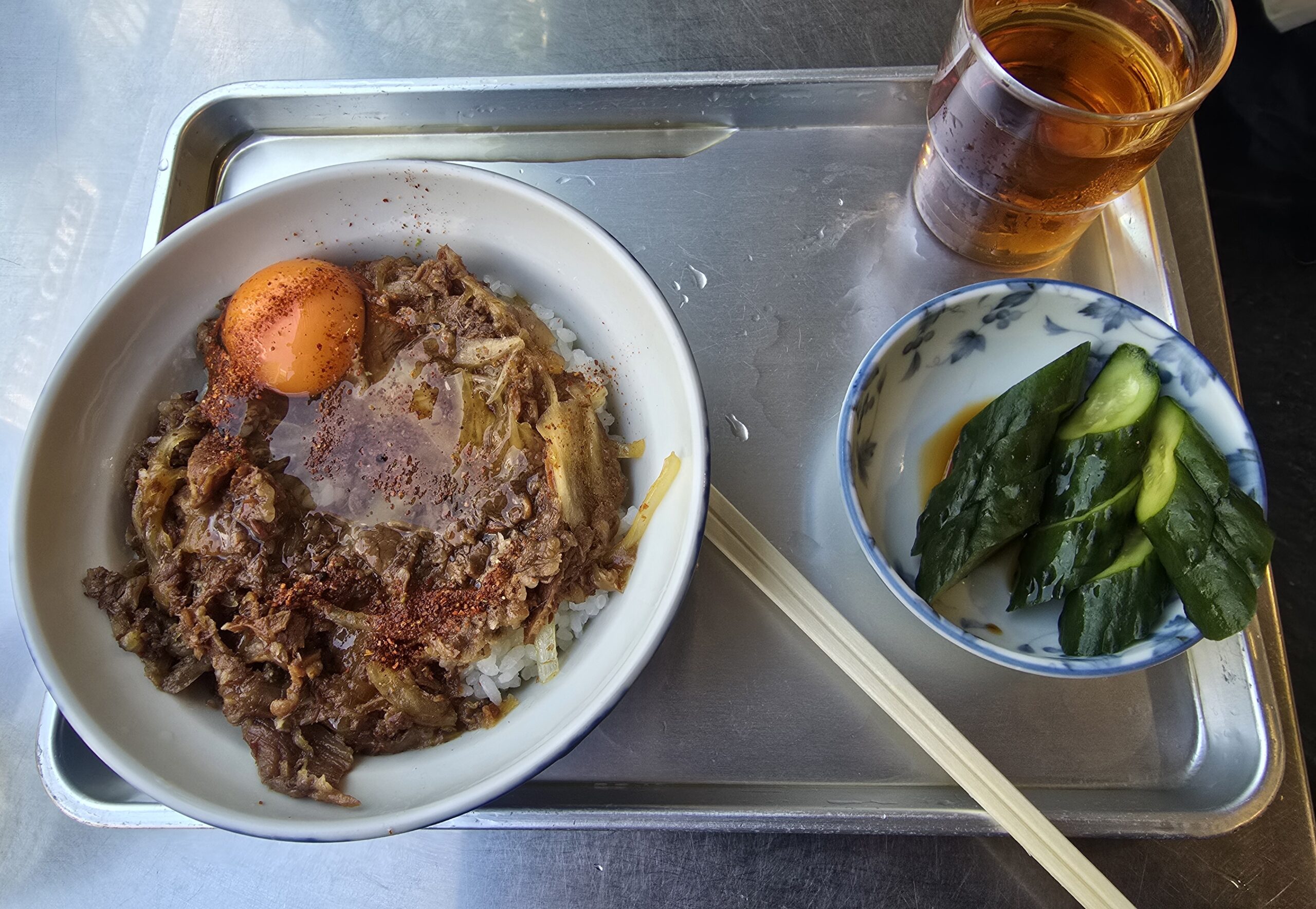
Truth be told, I’ve been to this shop more than twenty times, but almost every single time I ordered the horumondon. On other occasions, I’d just wash down their nikudofu (braised beef and tofu) and simmered horumon with a cold beer. I’ve actually only had their gyudon (beef bowl) once or twice. It’s not that their beef bowl isn’t good—it’s just that the horumondon is so exceptionally delicious that there was never any real reason to order beef instead. Besides, you can get gyudon anywhere, so I felt no urge to seek it out here.
While eating horumon on its own seems fairly common in Northern Kanto, in Tokyo, the only places where you can regularly find it are horumonyaki (grilled offal) joints—and even then, they rarely serve it as a rice bowl—or at racecourses and gambling dens. (This is a massive contrast to the Kansai region—though come to think of it, even in Kansai, dedicated horumondon spots might actually be pretty rare.)
Naturally, as I headed out on my little mission, I went in fully expecting the horumondon to hold an overwhelming lead.


Now, Kitsuneya is a tiny shop—just about 100 square feet—located along Shin-Ohashi Street, merely a minute’s walk straight from the subway station entrance to the Outer Market. However, Tsukiji has transformed into one of the world’s top tourist destinations. Even though I arrived at 10:00 AM on a weekday, the area was buzzing with international tourists, and the street was absolutely packed like a can of sardines.
There was a line of about ten people in front of Kitsuneya. Fortunately, the turnover here is lightning fast, so I was able to place my order in about five minutes, opting for the horumondon and a side of Japanese pickles (oshinko). Lady Luck was on my side, and I managed to grab a seat right at the counter. Before I knew it, my food was served.
As always, the offal—generously coated in a rich Hatcho miso sauce—was meticulously cleaned, completely free of any unpleasant odor, and absolutely exquisite. This is the taste of true craftsmanship with nearly 70 years of history behind it. In this old timer’s humble opinion, it just might be the absolute pinnacle of horumondon—perhaps even surpassing the authentic dote-horumon bowls of Osaka and Nagoya.
After thoroughly savoring my meal, I shifted into research mode to observe which dish was being ordered more: the gyudon or the horumondon.
Wait, what?! To my utter shock, the beef bowl was winning by a landslide—a 7-to-3 ratio!
Thinking there had to be some kind of mistake, but knowing my aging stomach couldn’t handle a second round right away, I decided to come back later. After all, gathering data at different times of the day only adds to the credibility of the research!


I wandered over to see what had become of the old inner market grounds, paid my respects at Namiyoke Shrine, and dropped by Tsukiji Hongwanji Temple, reflecting on how much the area has transformed.
Word has it that this former market site is going to be redeveloped into a complex with a stadium, high-rise apartments, and offices. They dress it up with fancy PR talk about creating an “international hub,” but I can already picture it: another thoroughly boring, cookie-cutter neighborhood. Anyone with common sense would agree they should have built the world’s greatest market district here instead. Instead, the inner market was uprooted and moved to Toyosu, leaving behind a bitter, frustrating compromise.
At this rate, even the outer market might disappear one day, eventually ending up like Odaiba—a place nobody visits anymore (with the Fuji TV building standing as a symbol of that decline). Real estate prices in Tokyo keep skyrocketing, turning the city into a playground for wealthy foreigners and high-rolling gamblers who succeeded in investments, while everyone else merely commutes here for work. I can’t help but envision a future where Tokyo transforms into a ghost town stripped of all Eros—of human vitality itself. (I plan to dive deeper into this topic in a future post on my other blog, Juro’s Melting & Drifting.)
Immersed in these arbitrary delusions, this old fool found his way back to Kitsuneya.
It was 12:00 PM, and the line had grown even longer—about 20 people now. But once again, the line moved quickly. This time, I grabbed a gyudon with a raw egg and carried my bowl over to the eating space along the street. It had been decades since I last ate Kitsuneya’s beef bowl; I had completely forgotten what it tasted like.
I took a big, energetic bite. A familiar taste hit me. Ah, right—it tastes a bit like the stewed beef at Shochan in Asakusa.
Well, comparison aside, in my book, the horumondon wins hands down. And yet, almost everyone around me was eating the beef bowl. Why?
The answer turned out to be dead simple. About half of the customers were international tourists, and offal is probably a bit too intense or challenging for them. (Which makes total sense, really.)
There I stood—an old timer feeling strangely saddened that my grand investigation had ended with such an obvious conclusion. Still, if you ask me, Japanese locals really ought to stick to the horumondon… But hey, to each their own (agree to disagree). Thanks for reading!
…Wait, hold on. A true old timer shouldn’t be so agreeable and understanding, should he? You’ve got to be more disliked and stubborn than that, Juro!
Shop Name: Kitsuneya
Genre: Beef Bowl (Gyudon), Offal Bowl (Horumon-don)
Inquiries: 03-3545-3902
Reservations: Not accepted
Address:
4-9-12 Tsukiji, Chuo-ku, Tokyo
Access:
5-minute walk from Tsukiji Station (Hibiya Line, Exit 1 or 2)
5-minute walk from Tsukiji Shijo Station (Toei Oedo Line, Exit A1)
295m from Tsukiji Shijo Station
Business Hours:
Mon, Tue, Thu, Fri, Sat
06:30 – 13:00
Closed: Wednesdays and Sundays
Business hours and closed days are subject to change; please check with the shop before visiting.
Payment Methods:
Credit cards not accepted
Electronic money not accepted
QR code payment not accepted
Seating:
5 seats (Counter seating only; standing dining at street-side tables is available.)
Non-smoking (entire premises)
The surrounding area is a designated no-smoking zone on the street.
Parking: None