Fifty years ago, when I was 15, I hated Adachi Ward so much that I just had to get out. (Back then, it was the kind of town where you’d get mugged almost every day just walking down the street.) But even back then, I felt that within Adachi Ward, Senju—the area surrounded by the rivers—had a higher level of refinement compared to the other towns across the Arakawa River, which felt more like part of the Saitama cultural sphere. (This is probably due to the difference in their historical backgrounds.) Some people refer to all of Adachi Ward as Tokyo’s Shitamachi (traditional downtown), but while Senju proudly wears the face of a true Shitamachi, the rest of Adachi is just suburbs and can hardly be called Shitamachi at all.
Having loathed Adachi Ward so much and sworn never to return, I now find myself visiting frequently because my work routine brings me through Kita-Senju. And I am simply astonished by how much it has changed. It routinely ranks high on lists of “Most Desirable Places to Live” (unbelievable!), and it now hosts two universities: Tokyo University of Science and Tokyo University of the Arts. (With all due respect, Geidai [Tokyo University of the Arts] and Adachi Ward felt so completely incompatible in my mind that I was truly in disbelief.) When I heard that the daily passenger count at Kita-Senju Station had surpassed Ueno Station, I was utterly blown away. Truth be told, back in the day, suburban locals from Adachi (and perhaps even today) would head straight to Ginza or Ueno whenever they had something special to celebrate, simply passing right through Kita-Senju. So, while I’ve been sounding like an expert sharing my deep wisdom on Adachi, the reality is that I’ve only recently gotten to know the town of Senju—I’m actually just a beginner here.


Well, I had heard rumors for a long time that the area was packed with retro, atmosphere-heavy drinking spots—like Ohashi for stew, Nagami for fried Senju-age, and Tenshichi for skewers—making it an irresistible haven for boozers. But when I revisited the town for a high school reunion after 40 years, looking around the streets, I couldn’t help but think: Isn’t this place a paradise for middle-aged guys like me?
Anyway, my introduction has grown long again, but today I’d like to introduce “Kashiwaya,” a traditional, no-frills noodle shop (taishū soba-ya) that has been in business in Senju for an impressive 120 years (founded in 1904, the 37th year of the Meiji era). It’s been around so long that it makes you wonder if even the famous author Mori Ōgai might have visited when he lived in Senju.
Though to be completely frank, it’s just an utterly ordinary neighborhood noodle shop. The soba is made of roughly 60% buckwheat flour and 40% wheat flour—a ratio that my grandfather from Yamagata would have indignantly declared, “This is just udon!” (Whenever he visited Tokyo during his lifetime, he would fly into a rage over Tokyo’s cheap soba. As a child watching him, I internally thought, Well, if you hate it that much, just don’t eat it! But looking back, it felt like he actually enjoyed getting angry, so he had his own fun with it).
If you ask me, though, this utter lack of pretension is precisely what makes it so great. Lately, these unassuming, classic noodle shops are becoming a rare breed. Now, what counts as a “pretentious” soba shop? The kind where a guy who quit his corporate job to pursue a mid-life passion rolls out noodles with a stubborn frown (always wearing a traditional craftsman’s samue robe), operating out of a self-consciously atmospheric storefront, serving trendy dishes alongside pre-noodle drinks—and the customers act all sophisticated, pretending to be connoisseurs as they eat. You see a lot of those around Ginza or Kagurazaka (which are quite different from genuinely historic, high-end establishments).
As for Kashiwaya: around 3:00 PM, looking for a late lunch, I set out in search of a humble soba shop, hoping to get a bowl of Ankake Udon (a thick-starchy soup udon, one of my absolute favorites). Thinking even Senju didn’t have many traditional soba shops left, I was walking down Shukuba-machi Street when I stumbled upon it by chance.
Stepping inside, it was the absolute embodiment of a classic taishū soba-ya. Wooden menu plaques were lined up neatly along the wall. There were three four-person tables on each side of the aisle, with the kitchen at the back and what looked like a second floor upstairs. Since it was way past regular meal hours, the only other customers were a couple and a single middle-aged man. Told to take any open seat, I settled into the middle table on the right side.
Thinking my order was already set, I idly flipped through the pages of the menu, only to find a mind-boggling variety of options. The selection of soba and udon was overwhelmingly complete—you rarely see a place with a lineup this thorough these days. The set meals were extensive, and they even offered a wide variety of creative original soba, including uniquely named dishes like “Jigoku” (Hell), “Sanzoku” (Bandit), and “Kaizoku” (Pirate). The side dishes to accompany drinks (soba-mae) were equally impressive, and since the shop stays open straight through the afternoon without a break, I quickly realized: This is an absolute gem for daytime drinking.
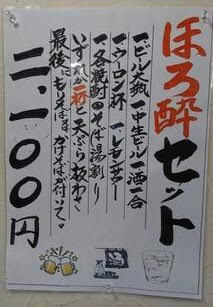
Deciding I might as well get a beer, I flipped to the beverage menu. But as I glanced at the wall beside me, the words “Horoyoi Set” (Tipsy Combo) caught my eye (see photo).
My initial resolve crumbled. An inner devil whispered conveniently to me: Hey, you’re a guy with nothing else to do today—wouldn’t this be much better?
When the waitress came to take my order, the words slipped right out of my mouth without any conscious effort: “An-… the Horoyoi Set, please.”
“What kind of alcohol would you like?” she asked.
“A large bottle, please.”
“Asahi or Kirin?”
“Asahi,” replied the middle-aged man sitting there.
Moments later, a genuine 633ml large bottle of Asahi appeared before me. (Usually, many places in Tokyo claim to serve “large bottles” when they’re actually medium ones).
Well, since it’s come to this, I might as well give it my all and drink up! I thought—though there was really no need to try so hard. I gulped down the beer. Ahhh, ice-cold and absolute bliss! As I poured a second glass down my throat, the first appetizer arrived: Itawasa (sliced fish cake with horseradish).
And this wasn’t just some token, half-hearted side dish. Looking at its tender texture, I wondered: Is this from Yamaguchi? Or perhaps Odawara, or Kibun? Six thick slices of kamaboko rested on the plate, accompanied by a surprisingly generous serving of seasoned mountain vegetables (sansai). The drinks were going down way too easily.
Then came the next appetizer: tempura. To my amazement, it came with a full spread of six items—shishito pepper, pumpkin, eggplant, shrimp, squid, and conger eel (anago).
With my beer completely finished, I decided to go for another round and ordered a glass of Unkai buckwheat shochu on the rocks (600 yen). Looking over, I noticed the couple nearby was also happily drinking their way through the “Horoyoi Set.”


The solo male customer was sipping hot soba while drinking a warm green tea shochu cocktail (Ocha-wari). There was something deeply peaceful and laid-back about the whole scene. It’s an unpretentious, incredibly easygoing place where you can just be yourself. Shops like this—where time flows at a gentle, slow, and relaxed pace—are becoming fewer and fewer. I’m sure during peak lunch hours, both the kitchen and the staff are running around like crazy, but sitting here, it feels as if nothing has changed since the Showa era.
Feeling pleasantly tipsy (horoyoi), I saved a few pieces of tempura to pair with my noodles and ordered a serving of cold Mori Soba. Before long, the noodles arrived. As I mentioned earlier, the soba itself is completely ordinary. For a place with a 120-year history, the dipping sauce lacks a sharp edge—it’s a bit weak and watery. But that’s precisely why it’s so good. I didn’t come here for some mind-blowing gourmet soba.
Traditional neighborhood shops like this might be an endangered species these days, but I truly hope they keep going forever. “I’m definitely going to be a frequent regular here from now on,” this middle-aged guy pledged to himself as I poured hot Soba-yu (soba water) into my remaining sauce and took a sip.
To get all of this for a grand total of just 2,700 yen—I can’t help but be deeply, deeply grateful. (I later heard that this “Horoyoi Set” is indeed an extraordinarily popular item on their menu.)
Kisoba Kashiwa-ya
Genre: Soba, Conger eel (anago), Pork cutlet bowl (Katsudon)
Reservations & Inquiries:
03-3881-2807
Reservations accepted
No reservations on weekends or public holidays
Address:
2-32 Senju, Adachi-ku, Tokyo
5-minute walk (0.4 km) from Kita-Senju Station; 249 meters from Kita-Senju Station
Business Hours:
11:00 – 20:30 (Last Order: 20:00)
Closed: None